What is Sugar Reset, exactly?
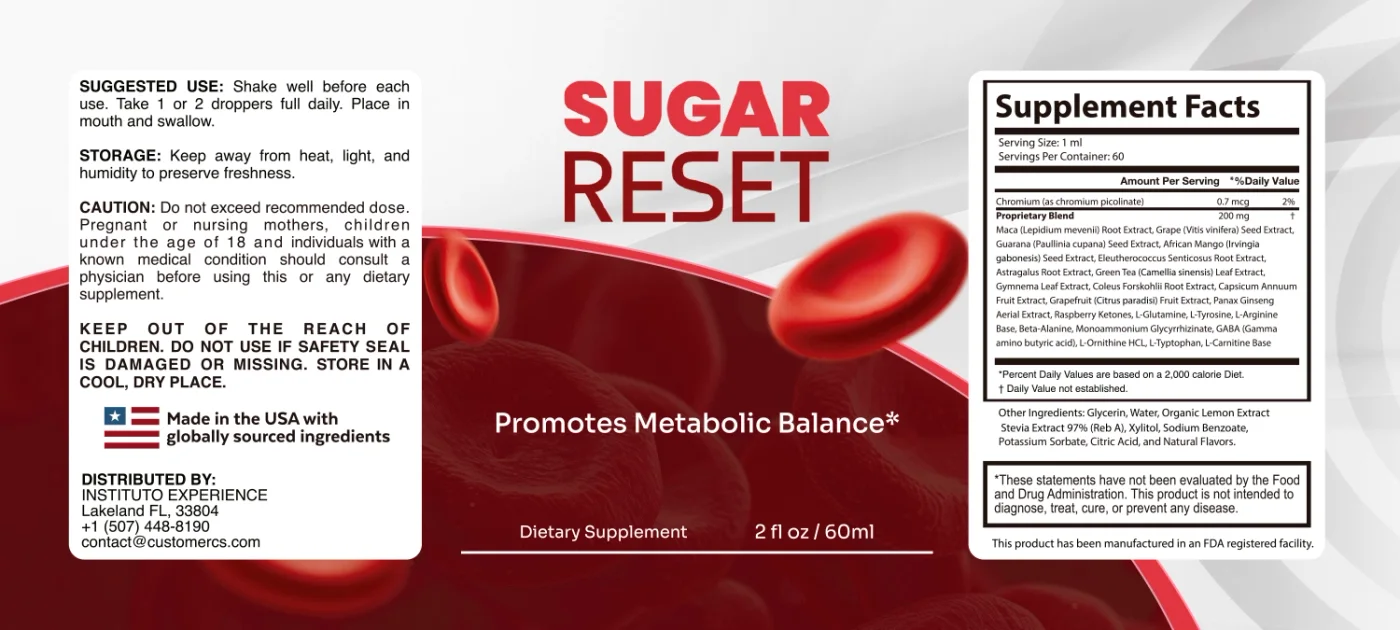
Sugar Reset is a liquid dietary supplement. It arrives as a 2 fl oz (60 ml) glass dropper bottle, and the suggested use printed on the label is simple: shake well, take one or two droppers full daily, place in mouth and swallow.
That format matters more than it sounds. If you already take several prescriptions each morning, a dropper is easier to add to a routine than another capsule. It is also harder to travel with, being glass, and it needs to stay upright.
The front of the label carries one claim: “Promotes Metabolic Balance.” That is worth pausing on, because the marketing around this product talks almost entirely about blood sugar. The regulated statement on the bottle itself is broader and vaguer than the sales pitch, which is a pattern you see across this category.
Before anything else. If you are managing diabetes or prediabetes, or taking any medication that affects blood glucose, no supplement is a substitute for that care and several ingredients in this formula can interact with medication. That conversation belongs with your doctor or pharmacist, not a review site. More on the specific interactions further down.
What does the printed label actually say?
Here is where most coverage of this product falls apart. Almost everything ranking on Google for Sugar Reset right now is a paid press release or sponsored content, and the published ingredient counts disagree with each other. One widely syndicated article says 22 ingredients. Several others say 21.
We photographed the physical panel and counted it line by line. The correct number is 23 active ingredients.
The Supplement Facts panel lists a serving size of 1 ml and 60 servings per container. It then lists exactly two entries:
| Entry on the panel | Amount per 1 ml serving | % Daily Value |
|---|---|---|
| Chromium (as chromium picolinate) | 0.7 mcg | 2% |
| Proprietary Blend (22 ingredients) | 200 mg | Not established |
The 22 ingredients inside that single 200 mg blend, in the order printed: Maca root, grape seed, guarana seed, African mango seed, Eleutherococcus senticosus root, astragalus root, green tea leaf, gymnema leaf, Coleus forskohlii root, Capsicum annuum fruit, grapefruit fruit, Panax ginseng aerial, raspberry ketones, L-glutamine, L-tyrosine, L-arginine, beta-alanine, monoammonium glycyrrhizinate, GABA, L-ornithine HCL, L-tryptophan and L-carnitine.
One small detail that tells you something about how carefully this label was produced: the printed panel misspells L-tryptophan as “L-Typtophan.” It is a typo on a physical product label, not on a webpage. It changes nothing about the formula, but it is not the sign of a heavily reviewed document.
Outside the Supplement Facts box, the label lists the non-active ingredients: glycerin, water, organic lemon extract, stevia extract 97% (Reb A), xylitol, sodium benzoate, potassium sorbate, citric acid and natural flavors.
Worth knowing: a “proprietary blend” is legal and extremely common. Under US labeling rules a manufacturer may declare the total weight of a blend without disclosing the individual amounts inside it, which protects the formula from being copied — and also makes it impossible for anyone outside the company to verify a single dose. Source: 21 CFR 101.36, FDA nutrition labeling of dietary supplements.
Why is everyone quiet about the chromium number?
Chromium is the one ingredient in this product with its own line and its own number: 0.7 mcg per serving, marked as 2% of the Daily Value.
Those two figures agree with each other. The Daily Value for chromium is 35 mcg, and 0.7 is 2% of 35. So this is not a misprint — the label means it.
The problem is scale. Chromium picolinate is the single most-studied ingredient in this formula for glucose-related outcomes, and the trials that produced those results did not use micrograms in the single digits.
The dose gap: the National Institutes of Health Office of Dietary Supplements notes that studies of chromium supplementation for glucose and insulin outcomes have typically used doses of 200 to 1,000 mcg per day, and that results across those trials have been mixed even at those levels. Source: NIH Office of Dietary Supplements, Chromium fact sheet.
At 0.7 mcg per serving, or 1.4 mcg if you take the higher two-dropper dose, Sugar Reset delivers a small fraction of one percent of the low end of that range. Whatever this product does or does not do, it is not doing it through a research-relevant chromium dose.
That is not the same as saying the product is worthless. It is saying that if chromium is the reason you were interested, the number on this label does not support that reason, and a standalone chromium picolinate supplement costs a few dollars a month.
What does 200 mg across 22 ingredients actually mean?
Two hundred milligrams is roughly the weight of a single standard aspirin tablet. That is the total for all 22 remaining ingredients combined.
If the blend were divided perfectly evenly — which no blend ever is — each ingredient would receive about 9 mg.
That ceiling needs no outside source at all. If the whole blend weighs 200 mg, then no single ingredient inside it can weigh more than 200 mg, and realistically each sits far below that. The arithmetic holds regardless of what any study says. The one dose we can actually check against published research is the chromium, and that section is above. For the amounts of each botanical, see our ingredient-by-ingredient breakdown.
In practice, blends are almost never even. Ingredients are listed in descending order by weight, so maca, grape seed and guarana — the first three — take up more of the 200 mg than the amino acids at the end of the list. Which specific ingredients received meaningful amounts, and which are present at trace levels for the sake of appearing on the label, is not something anyone outside the company can determine.
What this means for you as a buyer. A long ingredient list is a marketing asset, not a clinical one. Twenty-three named botanicals reads as thorough. Twenty-three names sharing 200 mg reads differently. When you compare this product to another, compare disclosed doses — not the length of the list.
How long does one bottle actually last?
This is the question almost nobody asks, and the answer is genuinely useful because the label allows two different doses.
The panel says 60 servings of 1 ml per bottle. The suggested use says one or two droppers full daily. A full dropper in a bottle this size holds roughly 1 ml.
| If you take | One bottle lasts | A 6-bottle order lasts | Chromium per day |
|---|---|---|---|
| 1 dropper daily | 60 days | About 12 months | 0.7 mcg |
| 2 droppers daily | 30 days | About 6 months | 1.4 mcg |
The seller's supply figures assume the higher dose. The order page describes 2 bottles as a 60-day supply, 3 bottles as 90 days and 6 bottles as 180 days — all of which only work out at 30 days per bottle, meaning two droppers a day.
So if you take the lower dose the label permits, your order lasts twice as long as advertised. That sounds like a win, and on cost per day it is. It also means you are taking half of doses that were already very small. There is no way to have both.
Does Sugar Reset work?
Honestly: nobody can tell you that from the outside, and anyone who states it flatly in either direction is guessing.
Here is what can be said with confidence. The formula contains ingredients with real research behind them for blood-sugar-adjacent outcomes — chromium picolinate and gymnema in particular. It also contains ingredients whose presence looks more like formulation padding than strategy: raspberry ketones and a spread of amino acids that have little to do with glucose metabolism.
What cannot be established is whether any of them are present at an amount that matters, because 22 of the 23 sit inside an undisclosed blend. There are no published clinical trials on this specific formulation. The testimonials on the sales page are not independently verifiable, which is true of essentially every product in this category.
The one thing you can hold them to. The 60-day money-back guarantee is a written commitment, and it is the only part of this offer that does not depend on trusting a marketing claim. But three different versions of it are in circulation, and only one of them binds — read that section before you order.
There is also a context worth keeping in view. The CDC reports that roughly 38% of US adults have prediabetes, the large majority of them undiagnosed. That is an enormous audience of people who have been told a number is drifting and given no clear next step, which is exactly the audience this entire product category is built for. Feeling motivated to do something is not evidence that a given something works.
Check the current price yourself
Sugar Reset sells only through its official site — there is no single-bottle option, and promotional pricing changes. The number that counts is the one on the final checkout screen, not the one on the sales page.
What does it really cost at checkout?
Sugar Reset runs from $49 to $79 per bottle depending on package size, and there is no single-bottle option — the smallest possible commitment is two. There is also no subscription and no auto-rebill, which is worth crediting: several competing offers in this category use a pre-ticked recurring charge, and this one does not.
Whatever package you pick, add $9.99. The order page badges the 3-bottle and 6-bottle packages as free shipping. When we put all three through checkout with a US billing address in August 2026, every one added a flat $9.99 shipping and handling charge anyway. It is under ten dollars, so it is not a scandal — but it is not what the page says.
The full package-by-package table, with each subtotal and the exact total charged at checkout, is in our complete Sugar Reset review. We keep it in one place so there is one set of numbers to maintain, not two.
Which version of the 60-day guarantee is real?
Three different versions of this guarantee are circulating, and they contradict each other.
| Where it appears | What it says |
|---|---|
| The written returns policy | 60 days, no minimum use, no restocking fee. |
| The sales page copy | 60 days, but only “after at least 30 days of use.” |
| Syndicated press releases | 60 days, 30-day minimum use, and a 20% restocking fee. |
The written policy is the one that binds you. It is the document a payment processor or a card issuer looks at in a dispute, and it is the one that survives a marketing page being rewritten.
The full comparison — the exact wording of all three sources, the policy's own purchase-vs-delivery contradiction, and the email steps — is in our breakdown of the Sugar Reset refund policy.
What are the six bonuses, and who actually gets them?
Orders of three or six bottles include six downloadable guides. They are digital only, delivered after purchase, and the seller puts a dollar value on each one:
| # | Bonus | Stated value |
|---|---|---|
| 1 | Diabetes Freedom | $67 |
| 2 | Fortifying Vitamins | $49 |
| 3 | Accelerated Metabolism | $59 |
| 4 | Nerve Renew Guide | $67 |
| 5 | Glycemic Rebalance Challenge | $39 |
| 6 | Personalized Usage Guide | $39 |
| Total stated value | $320 |
The two-bottle package does not include them — and the sales page is not clear about that. It advertises “6 free bonuses” in a benefits box that sits directly beside the two-bottle option. If the bonuses are part of why you are ordering, you have to order three or six bottles to get them.
Treat the $320 as a marketing figure, not a market price. These are PDFs, and nobody was ever going to pay $67 for one. What matters is the honest question: would you read them? If yes, they genuinely tilt the three-bottle package over the two-bottle one. If you know you will not open a PDF, they are worth zero and should not move your decision at all.
Is Sugar Reset a scam?
No, and it is worth being precise about why, because “scam” gets used loosely in this category.
A scam takes your money and delivers nothing, or bills you repeatedly without consent. Sugar Reset does neither. There is a named distributor with a physical address on the label — Instituto Experience, Lakeland, Florida — a phone number, a support email, a written refund policy with real terms, and a mainstream affiliate network handling the checkout. There is no hidden subscription.
The fair criticism is not fraud. It is transparency: a formula where 22 of 23 ingredients have no disclosed amount, a headline mineral at a fraction of any studied dose, a shipping charge that contradicts the badge on the order page, and testimonials nobody can verify.
Those are real objections, and they are why this product does not earn a top score from us. They are a different thing from theft.
Who should not take this?
The label's own caution reads: do not exceed the recommended dose; pregnant or nursing mothers, children under 18, and individuals with a known medical condition should consult a physician before use. Beyond that boilerplate, two ingredients deserve specific attention that the marketing does not give them.
Monoammonium glycyrrhizinate
This is a salt of glycyrrhizin, the active compound in licorice root. Glycyrrhizin can lower potassium levels and raise blood pressure with sustained intake — the NIH warns it can cause irregular heartbeat, especially in large amounts or with long-term use. The amount here is unknown, and it is likely small given the 200 mg total, but if you have high blood pressure, heart problems, kidney disease, or take a diuretic or a potassium-affecting medication, this is a conversation to have with a pharmacist. We cover each medication group in Sugar Reset and your medications.
Sources: NIH (NCCIH) on licorice root and glycyrrhizin and Memorial Sloan Kettering on licorice and low potassium.
Caffeine you were not told about
Guarana seed and green tea leaf both contain caffeine, and both are in the blend. No caffeine content is declared anywhere on the label. The amount is probably modest, but if you are caffeine-sensitive, take this earlier in the day rather than in the evening until you know how it sits with you.
Two more practical notes
- Xylitol is in the inactive ingredients. Harmless to people in these quantities, but xylitol is seriously toxic to dogs. Keep the bottle where a pet cannot reach it.
- Several ingredients here can affect blood glucose. That is the point of the product — but it also means that if you already take glucose-lowering medication, stacking them without medical supervision is exactly the wrong move.
The short version
Sugar Reset is a legitimate product with a real company behind it, a convenient format, a fully named ingredient list and a genuinely good refund policy. It is also a product where the one disclosed dose is very small, the other 22 ingredients are undisclosed, and the shipping badge does not match the checkout.
If you want to try it, the 60-day guarantee means your real risk is $9.99 of shipping plus the effort of a return. That is a reasonable bet on an uncertain outcome. Go in understanding what the label actually says — which, after this article, you now do — rather than what the sales page implies.
For the full scored breakdown, including how it compares on each criterion, see our complete Sugar Reset review.
Frequently Asked Questions
How many ingredients does Sugar Reset actually contain?
Twenty-three active ingredients. The printed Supplement Facts panel lists chromium as a standalone entry, then a 200 mg proprietary blend containing 22 further ingredients. Published counts of 21 and 22 are both wrong — we counted the panel line by line and published the photograph so you can count it yourself.
Is the chromium dose in Sugar Reset too low to do anything?
The label states 0.7 mcg of chromium, which it marks as 2% of the Daily Value. Clinical studies on chromium picolinate and glucose control typically use 200 to 1,000 mcg per day. At 0.7 mcg per serving the amount is a small fraction of any studied dose, and the label figure is internally consistent, so this is unlikely to be a typo.
Does Sugar Reset ship free?
No. The order page badges the 3-bottle and 6-bottle packages as free shipping, but when all three packages were put through checkout with a US billing address in August 2026, every one added a flat $9.99 shipping and handling charge. Budget the extra $9.99 whichever package you pick.
Is the Sugar Reset on Amazon the same product?
No. The product reviewed here is a liquid in a 2 fl oz dropper bottle sold through the official site. A separate capsule product also sells under the Sugar Reset name on Amazon. Different format, different seller, and the official 60-day guarantee covers the official site purchase, not a marketplace one.
Is there a subscription or rebill?
No. All three packages are one-time charges. There is no pre-ticked subscription box and no recurring billing, which is worth noting because several competing blood sugar offers do use auto-rebill.
Who distributes Sugar Reset?
The label names Instituto Experience of Lakeland, Florida, 33804, with a phone number and a contact@customercs.com support address. It states the product is made in the USA with globally sourced ingredients in an FDA-registered facility. FDA registration of a facility is not FDA approval of the product.

Daniel Whitaker
I buy the products I write about, photograph the physical label, and put every package through checkout before I publish a number. I am not a doctor, a dietitian, or a medical professional, and nothing here is medical advice.
This article contains affiliate links. If you buy through them we may earn a commission at no extra cost to you. It does not change the label counts, the checkout totals or the criticisms above.