How many ingredients does Sugar Reset really have?
Search for this product and you will find confident ingredient counts that contradict each other. One heavily syndicated article says 22. Several say 21. The manufacturer's own marketing is inconsistent about it.
We photographed the printed panel and counted it. There are 23 active ingredients.
The Supplement Facts box has exactly two entries: chromium, disclosed on its own line at 0.7 mcg per 1 ml serving, and a Proprietary Blend of 200 mg containing 22 further ingredients. One plus 22 equals 23.
Here is the panel. Count it yourself — that is the point.
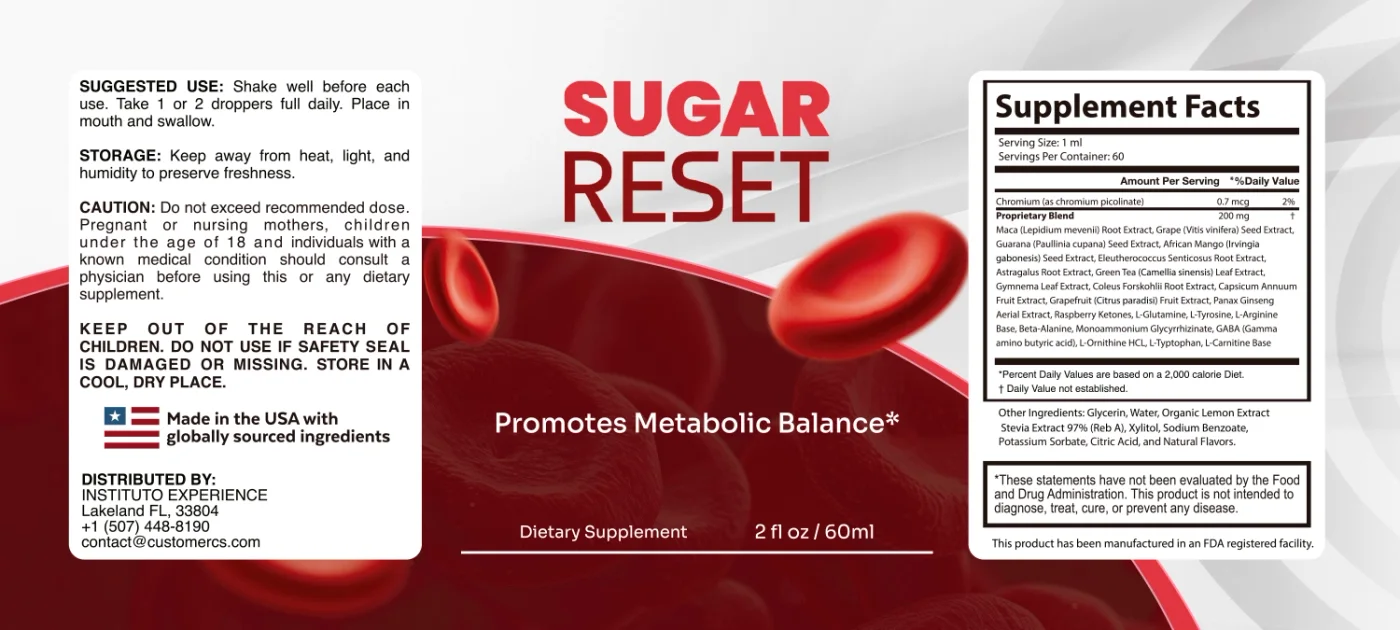
This matters less as trivia and more as a signal: if the basic count is being copied around the internet without anyone checking the bottle, treat every other claim you read about this product the same way.
What is the full list, in label order?
Blend ingredients are required to be listed in descending order by weight. So position in this list tells you something real: the first items take up more of the 200 mg than the last ones.
| # | Ingredient as printed | Commonly used for |
|---|---|---|
| — | Chromium (as chromium picolinate) — 0.7 mcg, disclosed | Insulin sensitivity |
| 1 | Maca (Lepidium meyenii) root | Energy, adaptogen |
| 2 | Grape (Vitis vinifera) seed | Antioxidant, circulation |
| 3 | Guarana (Paullinia cupana) seed | Caffeine, energy |
| 4 | African mango (Irvingia gabonensis) seed | Weight, metabolic markers |
| 5 | Eleutherococcus senticosus root | Adaptogen, fatigue |
| 6 | Astragalus root | Immune, adaptogen |
| 7 | Green tea (Camellia sinensis) leaf | Metabolism, antioxidant |
| 8 | Gymnema leaf | Sugar cravings, glucose |
| 9 | Coleus forskohlii root | Body composition |
| 10 | Capsicum annuum fruit | Thermogenesis |
| 11 | Grapefruit (Citrus paradisi) fruit | Metabolism |
| 12 | Panax ginseng aerial | Energy, glucose |
| 13 | Raspberry ketones | Marketed for fat loss |
| 14 | L-glutamine | Amino acid |
| 15 | L-tyrosine | Amino acid, focus |
| 16 | L-arginine | Amino acid, blood flow |
| 17 | Beta-alanine | Amino acid, endurance |
| 18 | Monoammonium glycyrrhizinate | Licorice derivative, flavor |
| 19 | GABA | Relaxation |
| 20 | L-ornithine HCL | Amino acid |
| 21 | L-tryptophan (printed “L-Typtophan”) | Amino acid, sleep |
| 22 | L-carnitine | Amino acid, fat transport |
Note item 21. The physical label misspells L-tryptophan. That is a typo printed on a product, not a typo on a webpage, and it says something about how many people reviewed this artwork before it went to press.
Which ingredients actually have blood sugar evidence?
Four, realistically.
Chromium picolinate
The most-studied ingredient here for glucose outcomes, and the only one with a disclosed amount. That amount is 0.7 mcg, which the label correctly marks as 2% of the Daily Value.
The NIH Office of Dietary Supplements notes that trials of chromium for glucose and insulin outcomes have generally used 200 to 1,000 mcg daily, with mixed results even at those doses. Source: NIH ODS, Chromium.
0.7 mcg is a fraction of one percent of the low end of that range. This is the clearest gap between what the product implies and what the label delivers.
Gymnema sylvestre
Genuinely interesting. Gymnema contains gymnemic acids that temporarily blunt the perception of sweetness on the tongue, which is a real, reproducible effect — chew a leaf and sugar tastes like sand for a while. It has been studied for glucose support in both traditional and modern contexts. Here it is the eighth item listed inside a blend totalling 200 mg, so whatever amount is present sits somewhere below that ceiling and is not disclosed.
Green tea leaf
Real research on metabolism and glucose handling, mostly built around its EGCG content. It sits seventh in the blend, again with no disclosed amount and the same 200 mg ceiling over it.
Panax ginseng
Some evidence for post-meal glucose response. Note the label specifies aerial extract — the stems and leaves — not the root, which is the part most ginseng research uses. That is a meaningful distinction and the marketing does not mention it.
Which ones are plausible but unproven?
Maca, grape seed, astragalus, Eleutherococcus, Coleus forskohlii, Capsicum, grapefruit and African mango all have some research behind them for something — energy, antioxidant activity, body composition, metabolic markers. None of them is a blood sugar ingredient in the way chromium or gymnema is, and none is present at a disclosed amount.
They are reasonable things to put in a wellness formula. They are not the reason anyone buys a blood sugar product.
Which Sugar Reset ingredients are just padding?
Nine of the 22 blend ingredients are amino acids or amino-acid-adjacent compounds: L-glutamine, L-tyrosine, L-arginine, beta-alanine, GABA, L-ornithine, L-tryptophan, L-carnitine, plus raspberry ketones sitting alongside them.
Amino acids are useful compounds. They are also cheap, they are individually studied at doses measured in grams, and they occupy the bottom half of a 200 mg blend that 22 ingredients are sharing.
The clearest example: the International Society of Sports Nutrition's position stand on beta-alanine recommends 4 to 6 grams per day to raise muscle carnosine. Source: Trexler et al., ISSN position stand: Beta-Alanine, J Int Soc Sports Nutr (2015). The entire proprietary blend in Sugar Reset is 0.2 grams — roughly one twenty-fifth of the low end of that range, before it is divided among 22 ingredients.
The honest read. These ingredients are almost certainly present at trace amounts. Their function on this product is more likely to be the label itself — a longer list reads as a more thorough formula — than any physiological effect. That is a common industry practice and it is not illegal. It is just worth recognising when you compare this to a competitor with six disclosed doses.
Raspberry ketones deserve a specific mention. They became popular after television promotion around 2012, and the human evidence for weight or metabolic effects has never caught up with the marketing. Their presence tells you something about how this formula was assembled.
Is there sugar or caffeine in it?
Outside the Supplement Facts box: glycerin, water, organic lemon extract, stevia extract 97% (Reb A), xylitol, sodium benzoate, potassium sorbate, citric acid and natural flavors.
Nothing alarming, and no added sugar — which would have been a genuinely bad look. Two notes:
- Xylitol is a sugar alcohol used here as a sweetener. Fine for people at this dose. Seriously toxic to dogs. Keep the bottle out of reach.
- Sodium benzoate and potassium sorbate are standard preservatives. A liquid supplement in a dropper bottle needs them.
The base being glycerin and water rather than alcohol is a small plus for taste and for anyone avoiding alcohol.
Is 200 mg enough for 22 ingredients?
Everything above collapses into one calculation. Twenty-two ingredients share 200 mg. That is roughly the weight of one aspirin tablet.
Split evenly, each ingredient gets about 9 mg. Blends are never split evenly — the first few take most of it — but that only means the ingredients at the bottom of the list get less than 9 mg, not more.
Compare that to the studied doses:
| Ingredient | Studied dose | Ceiling here | Source for the studied dose |
|---|---|---|---|
| Chromium picolinate | 200–1,000 mcg/day | 0.7 mcg (disclosed) | NIH ODS |
| Beta-alanine | 4,000–6,000 mg/day | Under 200 mg, shared | ISSN position stand |
| The other 21 | Not disclosed by the seller | Under 200 mg, shared | — |
The “ceiling” column needs no outside source at all — it comes from the label itself. If the whole blend is 200 mg, then no single ingredient inside it can exceed 200 mg, and realistically each is far below that. That arithmetic holds regardless of what any study says.
This is not a claim that the product does nothing. It is a claim that the label does not contain the information you would need to expect it to do something, and that the one number it does give you is very small.
Decide with the label in front of you
If the ingredient list still works for you — the format is convenient, the guarantee is real, and 60 days is enough time to judge — the official site is the only place it sells, and the only route where the refund policy applies.
So what should you take from this?
Sugar Reset has a fully named label, which is more than many competitors offer, and it includes genuinely well-studied ingredients. What it does not have is a single dose you can evaluate, other than a chromium figure that is far below any researched amount.
If you are comparing blood sugar supplements, the comparison that matters is not who lists more ingredients. It is who tells you how much of each. On that measure this product does poorly — and so, to be fair, do most of the products it competes with.
Next: our breakdown of the drops versus the capsules being sold on Amazon under the same name, which is the single most common way buyers of this product end up with something they did not intend to buy.
Frequently Asked Questions
Does Sugar Reset contain 21, 22 or 23 ingredients?
Twenty-three. Published counts disagree because most of them are copying each other rather than reading the panel. The printed Supplement Facts box lists chromium as its own entry, then a 200 mg proprietary blend containing 22 further ingredients. One plus 22 is 23.
How much gymnema is in Sugar Reset?
Not disclosed. Gymnema is the eighth ingredient listed inside a 200 mg blend shared by 22 ingredients. Since blend ingredients are listed in descending order by weight, seven ingredients weigh more than it and fourteen weigh less, but no individual amount is published anywhere.
Does Sugar Reset contain caffeine?
Yes, though no amount is declared. Guarana seed and green tea leaf are both in the blend and both naturally contain caffeine. Given the 200 mg total, the quantity is likely small, but caffeine-sensitive users should take it earlier in the day.
Is there sugar in Sugar Reset?
No added sugar. The liquid is sweetened with stevia extract 97% Reb A and xylitol, both listed among the inactive ingredients alongside glycerin, water, organic lemon extract, sodium benzoate, potassium sorbate, citric acid and natural flavors.
Are the ingredients in Sugar Reset safe?
Most are common supplement botanicals at what are almost certainly small amounts. Two deserve attention: monoammonium glycyrrhizinate is a licorice derivative that can raise blood pressure and lower potassium with sustained use, and the combined caffeine sources are undeclared. Anyone on medication for blood sugar or blood pressure should check with a pharmacist first.

Daniel Whitaker
I buy the products I write about, photograph the physical label, and put every package through checkout before I publish a number. I am not a doctor, a dietitian, or a medical professional, and nothing here is medical advice.
This article contains affiliate links. If you buy through them we may earn a commission at no extra cost to you. It does not change the label counts, the checkout totals or the criticisms above.