Does The Front Of The Bottle Even Mention Blood Sugar?
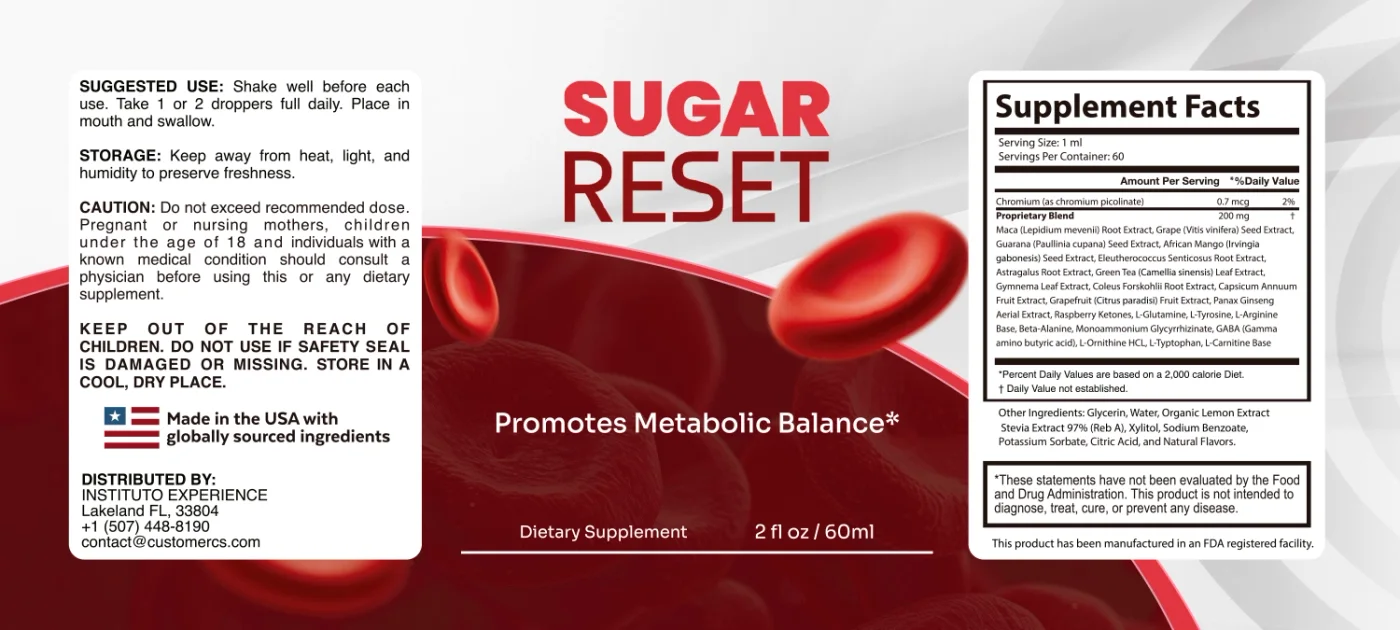
Start with something almost every review of this product misses, because it requires looking at the label rather than the sales page. The front of the Sugar Reset bottle does not say “blood sugar.” It says “Promotes Metabolic Balance.”
Why that wording is not an accident. A dietary supplement can make a structure/function claim like “supports metabolic balance,” but a claim to treat, prevent or manage a disease turns it into an unapproved drug in the FDA's eyes. Blood sugar management sits very close to that line. So the marketing leans on the association; the label stays on the safe side of it.
Keep that gap in mind as we go through the numbers, because the numbers say the same thing the label does.
Is 0.7 mcg Of Chromium Enough To Do Anything?
Chromium picolinate is the only ingredient on this label with its own line and its own number. Everything else is inside the blend. That makes it the easiest thing on the bottle to check — and the most revealing.
Chromium (as chromium picolinate): 0.7 mcg — 2% Daily Value
The 2% is not our calculation. It is printed on the label, in the right-hand column, by the manufacturer. A randomized, placebo-controlled trial in type 2 diabetes tested chromium picolinate at 200 and 1,000 mcg per day (PMID 17109595) — the low end of that trial alone is already 285 times more than this label.
| Amount per day | |
|---|---|
| Sugar Reset, one dropper | 0.7 mcg |
| Typical chromium research dose | 200–1,000 mcg |
| A supermarket chromium tablet | 200 mcg |
| The gap | roughly 285× to 1,400× |
Put plainly: a single chromium tablet costing a few cents contains about 285 times more chromium than a dropper of Sugar Reset. If chromium is the reason this product interests you, buying chromium on its own is cheaper and closer to what the research actually tested. And no, 0.7 mcg is not a typo we can explain — it is what the label states.
What Does 200 mg Split Among 22 Ingredients Actually Look Like?
Everything else sits inside a proprietary blend of 200 mg, shared between 22 named ingredients. The manufacturer does not publish how the 200 mg is divided.
Label rules require ingredients to be listed in descending order by weight, so we know maca, grape seed and guarana make up more of it than the amino acids at the end of the list. What we do not know is whether the first ingredient is 100 mg or 20 mg.
The arithmetic anyone can do. If the 200 mg were split evenly — and there is no reason to think it is — each ingredient would receive about 9 mg. Hold that number next to the doses in the table below.
How Do The Doses Compare To Published Research?
These are the amounts used in published human studies for the best-researched ingredients in the blend, next to what an even split of 200 mg would give you. Every source below is a real, checkable study, not a general claim.
| Ingredient | If split evenly | Used in human research | Gap | Source |
|---|---|---|---|---|
| Chromium picolinate listed separately | 0.7 mcg | 200–1,000 mcg | ~285× to 1,400× | PMID 17109595 |
| Gymnema sylvestre leaf | ~9 mg | 200–400 mg | ~22× to 44× | PMID 2259216 |
| Green tea leaf | ~9 mg | 300–400 mg | ~33× to 44× | PMID 21649457 |
| Panax ginseng | ~9 mg | 200–400 mg | ~22× to 44× | PMID 16401645 |
| Maca root | ~9 mg | 1,500–3,000 mg | ~166× to 333× | PMID 12472620 |
| African mango seed | ~9 mg | 150–300 mg | ~16× to 33× | PMC2651880 |
One detail worth pausing on: Panax ginseng is listed as an aerial extract — the leaf and stem, not the root almost all ginseng research (including the trial linked above) actually uses. So even at a research-level dose, it would not be the same ingredient the studies tested. And a brewed cup of green tea delivers far more catechin than 9 mg of extract — you would get more of the studied compound from a teabag than from this bottle.
Does Sugar Reset Contain Caffeine?
The label does not list caffeine on its own, but two ingredients in the blend contain it naturally: guarana seed extract and green tea leaf extract. The amounts are almost certainly tiny, for the same reason everything else here is small, since all 22 blend ingredients share 200 mg between them. Worth knowing if you are sensitive to stimulants or take this in the evening.
Two other things on this label that deserve a mention, and rarely get one. The blend contains monoammonium glycyrrhizinate, a licorice derivative that can raise blood pressure and lower potassium in some people at meaningful doses. And the sweetener is xylitol, which is harmless to humans and seriously toxic to dogs. Keep the bottle where a pet cannot reach it.
Could Something Else Explain Why People Feel Better?
If someone tells you Sugar Reset helped them, we have no reason to think they are lying. But “it helped” and “the formula did it” are different statements. Almost nobody buys a blood sugar supplement and changes nothing else — people start reading labels, cut the evening snack, walk more. Expectation itself is measurable in controlled trials. And blood glucose moves on its own, with sleep, stress and what you ate yesterday. None of that means the supplement gets the credit by default.
If you want to test it against the guarantee
Sugar Reset sells only through its own site, and that is the only route where the 60-day refund policy applies — the one with no minimum use period and no restocking fee. There is no single-bottle option and no subscription. Check the price yourself before ordering: the final checkout screen is the only number that counts, because shipping is added there.
So should you buy it?
Here is our honest position, stated as plainly as we can.
The product is legitimate. Real ingredients, all named on the label rather than hidden. A written 60-day refund policy with no minimum use period and no restocking fee — we read it, and it is more generous than most in this category. No subscription and no rebill at checkout. Sweetened with stevia and xylitol rather than sugar.
The doses are not. Not one ingredient on this label reaches an amount that published research would recognise. That is the whole review, and no amount of marketing changes it.
If you want to try it anyway — and there is nothing wrong with that — do it with a number, not a feeling. Get a fasting reading before you start, finish a full bottle (30 days at two droppers a day), and test again. The 60-day policy still leaves you a month to ask for a refund either way.
And if you take medication for blood sugar, speak to your doctor first. Gymnema and chromium can both lower glucose. Combined with medication that does the same thing, the risk is going too low. That warning matters more than everything else on this page.
Full label, pricing and guarantee wording: our Sugar Reset review. Ingredient-by-ingredient walkthrough: our ingredients breakdown.
Frequently Asked Questions
Does Sugar Reset actually lower blood sugar?
We have not seen evidence that it does, and the label does not claim it. The front of the bottle says "Promotes Metabolic Balance" — not blood sugar. The ingredient with the strongest glucose research behind it, chromium picolinate, is present at 0.7 mcg, which the label lists as 2% of a daily value. Human studies on chromium and blood glucose used 200 to 1,000 mcg per day. If your numbers improve while taking it, the honest first suspects are diet, medication, sleep and weight, not the supplement.
How long does Sugar Reset take to work?
Nobody can answer that for you, including the seller, because there is no published trial of this formula at these amounts. What we can tell you is what to do with the uncertainty: the refund policy gives you 60 days from purchase with no minimum use period. One bottle at two droppers a day is 30 days. That means you can finish a bottle, decide honestly whether anything changed, and still be inside the window.
Why does the label not say "blood sugar" on the front?
Because of how supplement labelling works in the United States. A dietary supplement may make a structure/function claim such as "supports metabolic balance", but a claim to treat, prevent or manage a disease turns the product into an unapproved drug in the eyes of the FDA. Blood sugar management sits close to that line. The marketing around the product leans on the association; the label itself stays on the safe side of it.
Are the ingredients in Sugar Reset fake?
No. Every ingredient on the label is a real, identifiable botanical or amino acid, and several of them — gymnema, chromium, green tea, ginseng — have genuine published research. The criticism in this article is not about what is in the bottle. It is about how much of it is in there.
If the doses are that small, why do some people say it helped?
Several reasons that have nothing to do with fraud. People who buy a blood sugar supplement usually change something else at the same time — they start paying attention to what they eat, they weigh themselves, they walk more. Expectation itself produces measurable effects in trials. And blood glucose moves for many reasons day to day. None of that means someone is lying about feeling better; it means the supplement is not the only candidate for the credit.
Is Sugar Reset a scam?
Not in the fraud sense. The ingredients are real and named on the label rather than hidden, the refund policy is 60 days in writing with no minimum use period, and there is no subscription or hidden rebill at checkout. The honest criticism is not that it is a scam — it is that every dose on the label runs far below the amounts used in published research, so you are paying for a legitimate product that is unlikely to do much at these amounts.

Daniel Whitaker
I buy the products I write about, photograph the physical label, and put every package through checkout before I publish a number. I am not a doctor, a dietitian, or a medical professional, and nothing here is medical advice.
This article contains affiliate links. If you buy through them we may earn a commission at no extra cost to you. It does not change the label counts, the checkout totals or the criticisms above.