People keep asking us which of these two is better, and they ask it because the two names sit next to each other in the search results while nothing on either sales page explains the relationship.
So I did the only thing that settles it. I read both Supplement Facts panels. Here is what they say.
Are Sugar Reset and Glyco Reset the same formula?
Close enough that the difference will not matter to most buyers, and the panels say so in numbers you can check.
| Printed on the panel | Sugar Reset | Glyco Reset |
|---|---|---|
| Serving size | 1 ml | 1 ml |
| Chromium (as chromium picolinate) | 0.7 mcg · 2% DV | 0.7 mcg · 2% DV |
| Proprietary blend, total weight | 200 mg | 200 mg |
| Ingredients inside that blend | 22 | 21 |
| Servings per container | 60 | 30 |
| Bottle size | 2 fl oz / 60 ml | 1 oz / 30 ml |
| Suggested use | 1 to 2 droppers full daily | 1 dropper full daily |
| Front-of-bottle claim | “Promotes Metabolic Balance” | “Supports Healthy Glucose Utilization” |
Two products, sold by two different companies, arriving at the same 1 ml serving, the same mineral at the same two-decimal figure, and the same blend weight to the milligram. Twenty-one of the blend ingredients match, in language close enough to come from one source document.
What I am not claiming. I cannot tell you from the outside that one factory fills both bottles, or that one company owns the other. Nothing public establishes that, and I am not going to invent it. What I can tell you is what two printed panels declare, and per serving they declare the same thing.
What does the Glyco Reset label actually say?
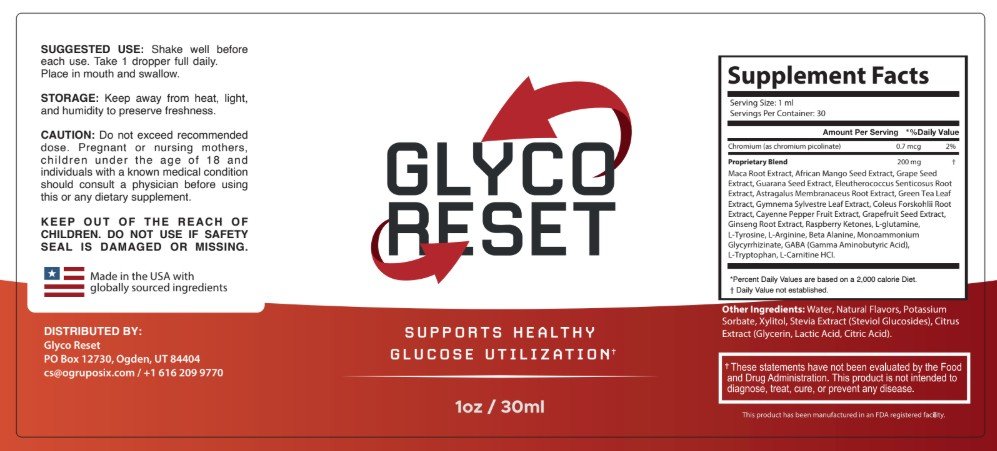
The Supplement Facts panel on the Glyco Reset artwork lists two entries, exactly like Sugar Reset does.
| Entry on the Glyco Reset panel | Amount per 1 ml serving | % Daily Value |
|---|---|---|
| Chromium (as chromium picolinate) | 0.7 mcg | 2% |
| Proprietary Blend (21 ingredients) | 200 mg | Not established |
The 21 ingredients inside that blend, in the order printed: maca root, African mango seed, grape seed, guarana seed, Eleutherococcus senticosus root, Astragalus membranaceus root, green tea leaf, Gymnema sylvestre leaf, Coleus forskohlii root, cayenne pepper fruit, grapefruit seed, ginseng root, raspberry ketones, L-glutamine, L-tyrosine, L-arginine, beta-alanine, monoammonium glycyrrhizinate, GABA, L-tryptophan and L-carnitine HCL.
The other ingredients, outside the Facts box: water, natural flavors, potassium sorbate, xylitol, stevia extract (steviol glucosides) and citrus extract (glycerin, lactic acid, citric acid).
The same ceiling applies here that applies to Sugar Reset, and it needs no outside source. If the whole blend weighs 200 mg, no ingredient inside it weighs more than 200 mg, and with 21 of them sharing that space an even split would be roughly 9 mg each. Blends are never even — they are listed in descending order by weight — so maca, African mango and grape seed take more of the 200 mg than the amino acids at the end of the list. Which ones are present at an amount that matters is not something anyone outside the company can determine.
The chromium figure deserves the same scrutiny on both labels.
The dose gap, on both products: the National Institutes of Health Office of Dietary Supplements notes that studies of chromium supplementation for glucose and insulin outcomes have typically used 200 to 1,000 mcg per day, with mixed results even at those levels. At 0.7 mcg per serving, both of these deliver a small fraction of one percent of the low end of that range. Source: NIH Office of Dietary Supplements, Chromium fact sheet. Our full breakdown is in the ingredient-by-ingredient article.
Where do the two labels disagree?
There are four real differences in the ingredient lists, and one of them is a missing ingredient.
| On the Sugar Reset panel | On the Glyco Reset panel | What changed |
|---|---|---|
| L-ornithine HCL | Not listed | Present on one panel, absent from the other |
| Panax ginseng aerial | Ginseng root | Different part of the plant |
| Grapefruit fruit | Grapefruit seed | Different part of the plant |
| Capsicum annuum fruit | Cayenne pepper fruit | Same plant, common name instead of Latin |
The ginseng and grapefruit entries are not cosmetic. Ginseng root and ginseng aerial parts are different raw materials with different compound profiles, and the same is true of grapefruit fruit versus grapefruit seed. Neither label discloses an amount for either, so there is nothing further to compare.
There is also a small printing detail worth recording. The physical Sugar Reset label misspells L-tryptophan as “L-Typtophan.” The Glyco Reset panel spells it correctly. It changes nothing about either formula, but if you were wondering which artwork was proofread more carefully, that is your answer.
Glyco Reset’s own website does not match Glyco Reset’s own label. The ingredient answer in the FAQ on getglycoreset.com lists Panax ginseng aerial, grapefruit fruit, Capsicum annuum and L-ornithine HCL — that is the Sugar Reset list, word for word, including the ingredient that does not appear on the Glyco Reset panel. The label image published on the same site says something different. When a page and its own label disagree, the label is the document that ships with the bottle.
Which one gives you more for the same money?
The prices are not similar. They are the same number.
Both order pages sell 2, 3 and 6-bottle packages at $79, $69 and $49 per bottle, for totals of $158, $207 and $294. There is no single-bottle option on either.
What differs is what arrives. A Sugar Reset bottle holds 60 servings. A Glyco Reset bottle holds 30.
| Package | Price (both) | Servings, SR | Servings, GR | Per serving, SR | Per serving, GR |
|---|---|---|---|---|---|
| 2 bottles | $158 | 120 | 60 | $1.32 | $2.63 |
| 3 bottles | $207 | 180 | 90 | $1.15 | $2.30 |
| 6 bottles | $294 | 360 | 180 | $0.82 | $1.63 |
It is exactly double at every package size, because the serving count is exactly half and the price is exactly equal. Six bottles of Sugar Reset is 360 ml of liquid for $294. Six bottles of Glyco Reset is 180 ml for $294.
The honest qualifier. Sugar Reset’s label permits one or two droppers a day. If you take two, a bottle lasts 30 days and your cost per day becomes $1.63 on the 6-bottle package — identical to Glyco Reset. The saving is real only if you take the lower dose the Sugar Reset label allows. Per milligram of formula, these two cost the same.
One more thing the arithmetic exposes. Both order pages describe 2 bottles as a 60-day supply, 3 as 90 days and 6 as 180 days. For Glyco Reset that is honest: 30 servings, one dropper a day, 30 days a bottle. For Sugar Reset those figures only work if you take two droppers daily, which the label allows but does not require. Glyco Reset’s supply claim matches its own panel. Sugar Reset’s does not, unless you assume the higher dose.
Shipping, and what I could and could not check. Both pages badge the 3 and 6-bottle packages as free shipping and mark the 2-bottle package “+ shipping.” When we ran all three Sugar Reset packages through checkout with a US billing address in August 2026, every one added a flat $9.99 shipping and handling charge anyway. I have not put a Glyco Reset order through checkout, so I cannot tell you what its checkout adds. Treat that line as unverified for Glyco Reset and budget for it.
Check the current price before you decide
Sugar Reset sells only through its official site, with no single-bottle option and no subscription billing. Promotional pricing changes on both of these products, and the number that counts is the one on the final checkout screen.
Which guarantee is easier to actually use?
Both advertise 60 days. Read past the badge and they are not the same promise.
| Term | Sugar Reset | Glyco Reset |
|---|---|---|
| Window | 60 days | 60 days |
| Clock starts | Purchase date in the intro, delivery in Step 1 | Delivery, stated the same way twice |
| Minimum use required | None in the written policy | None in the written policy |
| Restocking fee | None | None |
| Return authorization | Not required by the written policy | Required by the FAQ, not by the refund page |
| Who pays return shipping | Buyer | Buyer |
| What you send back | Product, per the returns policy | All bottles, opened or unopened, plus the packing slip |
Glyco Reset wins the clarity point on the clock. Its refund page says you have “60 days from the moment your order is delivered,” then repeats delivery in Step 1 and tells you to verify the date with your shipment tracking. That is unambiguous. The Sugar Reset written policy opens on the purchase date and then contradicts itself in Step 1 — we pulled that apart in the refund policy breakdown.
Glyco Reset loses the point again in its own FAQ. The FAQ on its homepage says a return authorization “must be requested and approved within 60 days of your date of purchase,” and that once an RMA is issued you must return the product “within 14 days of receipt of RMA,” in “good physical condition.” None of that appears on the refund page. So Glyco Reset has a clean policy page and a stricter FAQ that contradicts it, which is the same species of problem Sugar Reset has, in a different place.
Both read in full: the Glyco Reset refund policy, and the Sugar Reset returns policy hosted at lp.institutoexperience.com.br/returns/. Read the written policy, not the badge. The written document is what a card issuer looks at in a dispute.
Who is behind each product?
Neither is anonymous, and neither is a household name.
| Sugar Reset | Glyco Reset | |
|---|---|---|
| Distributor on the label | Instituto Experience | Glyco Reset |
| Address on the label | Lakeland, Florida 33804 | PO Box 12730, Ogden, UT 84404 |
| Support contact | Email address printed on the label | cs@ogruposix.com · +1 616 209 9770 |
| Policies hosted at | lp.institutoexperience.com.br | getglycoreset.com |
| Checkout handled by | Affiliate network checkout | JVZoo |
| Bonus ebooks included | Six, on 3 and 6-bottle orders | None found on the order page |
Sugar Reset puts a company name and a city on the bottle. Glyco Reset puts a PO Box. Both labels carry the same boilerplate: made in the USA with globally sourced ingredients, manufactured in an FDA-registered facility. FDA registration of a facility is not FDA approval of a product, and it never has been.
The six bonus ebooks are a genuine point for Sugar Reset if you will read them, and worth nothing if you will not. We listed all six and their stated values in the buyer’s guide.
Is the berberine “Glyco Reset” the same product?
No, and this is where buyers get hurt.
The name Glyco Reset is attached to more than one formula. A press release published in July 2026 describes a GlycoReset built on berberine bark, Ceylon cinnamon, gymnema, bitter melon, banaba leaf, chromium picolinate, juniper berry and licorice root, sourced to Wilmington, Delaware, with a 180-day empty-bottle guarantee and a different support phone number.
Compare that to the panel at the top of this page. Beyond chromium picolinate and gymnema, they share nothing. Berberine, cinnamon, bitter melon and banaba do not appear on the label shown above. Maca, grape seed, guarana and African mango do not appear on theirs. These are two unrelated products wearing one name.
Sources: the July 2026 GlobeNewswire release describing the berberine formula, and the Trustpilot page for glycoreset.lovable.app, which shows a 1.4 out of 5 TrustScore across 51 reviews, roughly 90% of them one star, with complaints about duplicate charges, damaged bottles and unresponsive support.
That 1.4-star page is not about either product on this page. It belongs to a third site. We covered the same mix-up from the other direction in the complaints article. Before you order anything called Glyco Reset, look at the Supplement Facts image on the site you are actually on and check whether it says berberine or maca. They are not the same purchase, and they do not share a refund policy.
Which one should you buy?
On the evidence above, if you want this formula, Sugar Reset is the better-value version of it, and the reason is not subtle. Same serving, same chromium figure, same 200 mg blend, same price per bottle, twice the liquid. It also names a company and a city on the label instead of a PO Box, and it includes six bonus guides on the larger packages.
Glyco Reset is genuinely better on two points, and they are worth stating plainly. Its refund page is clearer about when the 60 days begin, and its supply claim matches its own serving count without assuming you take the higher dose. Its front-of-bottle claim is also the more specific of the two.
And here is what neither one escapes: one disclosed dose per serving, at a fraction of any studied amount, with everything else inside a 200 mg blend nobody outside the company can break down. Choosing between these two is choosing a package size and a refund process. It is not choosing between two different levels of evidence. Whether this category does anything for you is a separate question, and we took it apart in the article on whether Sugar Reset works.
If you are managing diabetes or prediabetes, or you take anything that affects blood glucose, this is not the important decision. That conversation belongs with your doctor or pharmacist. Several ingredients in both blends — including monoammonium glycyrrhizinate, which is a licorice compound — can interact with medication, and neither label tells you how much of it you are getting.
For the scored breakdown, the package table and the checkout totals in one place, see our complete Sugar Reset review.
Frequently Asked Questions
Are Sugar Reset and Glyco Reset the same product?
They are not sold by the same company, but their Supplement Facts panels are nearly identical. Both declare a 1 ml serving, 0.7 mcg of chromium at 2% of the Daily Value, and a 200 mg proprietary blend. Twenty-one of the blend ingredients are the same on both labels. We cannot confirm from the outside whether one company makes both.
Which is cheaper, Sugar Reset or Glyco Reset?
The price per bottle is identical: $79, $69 and $49 per bottle for the 2, 3 and 6-bottle packages, with the same $158, $207 and $294 totals. But the Sugar Reset bottle is 2 fl oz with 60 servings and the Glyco Reset bottle is 1 oz with 30 servings, so Sugar Reset gives you twice as many servings for the same money.
What is on the Glyco Reset label that is not on Sugar Reset?
Nothing extra. The difference runs the other way. The Glyco Reset panel lists 21 ingredients in its blend, while the Sugar Reset panel lists 22. L-ornithine HCL appears on the Sugar Reset panel and not on the Glyco Reset one. Glyco Reset also lists ginseng root and grapefruit seed where Sugar Reset lists Panax ginseng aerial and grapefruit fruit.
Do Sugar Reset and Glyco Reset have the same guarantee?
Both advertise 60 days. The Glyco Reset refund page says the 60 days start when the order is delivered and is consistent about it, which is clearer than the Sugar Reset written policy. But the Glyco Reset FAQ adds a return authorization step and a 14-day return window after the RMA is issued, and that FAQ contradicts its own refund page.
Who distributes Glyco Reset?
The Glyco Reset label reads “Distributed by: Glyco Reset, PO Box 12730, Ogden, UT 84404,” with the email cs@ogruposix.com and the phone number +1 616 209 9770. That is a PO Box, not a street address. The Sugar Reset label names Instituto Experience of Lakeland, Florida, 33804.
Is the Glyco Reset with berberine the same product?
No. A July 2026 press release describes a different product under the GlycoReset name built on berberine, Ceylon cinnamon, bitter melon, banaba leaf, juniper berry and licorice root, sourced to Wilmington, Delaware, with a 180-day empty-bottle guarantee. That formula shares no botanicals with the maca-and-grape-seed blend on the label we photographed, beyond chromium picolinate and gymnema.

Daniel Whitaker
I buy the products I write about, photograph the physical label, and put every package through checkout before I publish a number. I am not a doctor, a dietitian, or a medical professional, and nothing here is medical advice.
This article contains affiliate links. If you buy through them we may earn a commission at no extra cost to you. It does not change the label counts, the checkout totals or the criticisms above — including the ones that point away from the product we earn on.